

Selection|What is an ATS Automatic Transfer Switch Cabinet? Principle of Automatic Switching from Utility Power to Generator During Power Outages (Suitable for Beginners)
Sep 18, 2026
Leave a message
 Selection|What is an ATS Automatic Transfer Switch Cabinet? Principle of Automatic Switching from Utility Power to Generator During Power Outages (Suitable for Beginners)
An unmanned standby power supply requires an ATS automatic transfer cabinet, which is essential for critical power usage scenarios such as machine rooms, factories, supermarkets, and breeding bases. It does not require manual switching or monitoring; when the mains power fails, it automatically starts the generator to supply power, and when the mains power is restored, it automatically switches back to the mains and shuts down the generator, all without any human operation. Today, this article explains what ATS is, the principle of automatic power transfer, and clarifies the key points of power matching.
1. What exactly is an ATS Automatic Transfer Switch Cabinet?
ATS stands for Automatic Transfer Switch. The complete cabinet is paired with an intelligent controller and dual power circuit breakers, serving as the core power distribution equipment connecting the utility grid and a diesel generator set. Simply put, it is equivalent to the "brain" of the entire emergency power supply system, monitoring the status of two power sources in real-time 24 hours a day: the utility grid as the main power source and the generator set as the backup power source. Without an ATS, after a power outage, personnel must be present to start and manually close the circuit to supply power; when power returns, manual switching and generator shutdown are also required, resulting in long power interruption times, high labor costs, and frequent risks of equipment downtime, data loss, and production losses. Installing an ATS enables fully automated monitoring, making high-standard backup power a standard feature.
2. Complete working principle of automatic generation during utility power outage
The entire switching process is divided into four stages, with a closed logical loop that eliminates the risk of a short circuit from both power sources being connected simultaneously:
2. 1. Real-time monitoring with delayed confirmation:
The ATS controller continuously detects utility voltage, frequency, and the three-phase phase. In the event of under-voltage, phase loss, or voltage deficiency, the generator will not start immediately. A built-in 3-10 second delay buffer filters out temporary grid fluctuations to avoid frequent starts and stops that can damage the equipment. If the utility power is still abnormal after the delay, a start signal is immediately sent to the generator set.
2.2. Generator start and stabilized power generation:
The generator receives the signal and automatically ignites to start. After idling and warming up, it gradually takes on load. The ATS continuously monitors the generator output parameters, and only when voltage and frequency are stable does the switching step occur, preventing unstable current from impacting the downstream load.
2.3. Power outage switching:
Load transfer to generator power follows the "break first, then make" safety logic: the utility circuit breaker is opened first, then the generator power circuit is closed, allowing all loads to seamlessly transfer to generator power.
2.4. Automatic return and generator shutdown when utility returns:
After the grid stabilizes, the ATS is set to a delay of about 30 seconds to confirm the utility is stable and free of fluctuations. It then automatically disconnects the generator circuit and closes the utility circuit to restore power. After running the generator under no-load to cool, the diesel engine automatically shuts down, returning the entire system to standby monitoring mode to await the next outage.
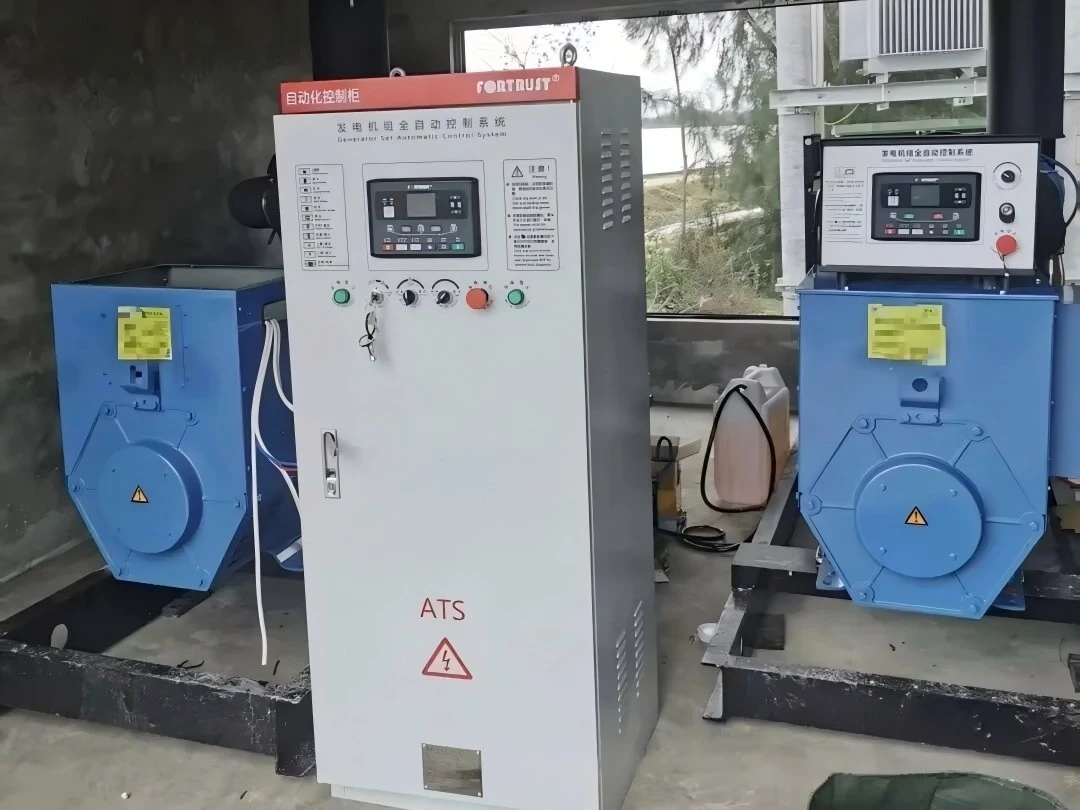
3. Key points for ATS power core selection
Power matching is crucial for the stable operation of an ATS, and incorrect selection can easily cause overheating and switch burnout:
1. First, calculate the maximum simultaneous load power of the factory or computer room to determine the generator set power, then convert the corresponding current to match the ATS;
2. The ATS rated current should be greater than or equal to the generator's full-load output current. It should not be smaller, otherwise high current closing can burn the contacts and cause safety hazards;
3. For loads with high starting currents, such as multiple motors or compressors, choose an ATS rated one step higher to handle the instantaneous starting current impact;
4. For long-term full-load operation scenarios, prioritize metal cabinets, thickened copper bars, and industrial-grade controllers for enhanced durability.
ATS is the core component of an unattended backup power supply. Understanding its principles and mastering the selection rules can not only ensure stable power supply during outages but also help avoid layers of price markups by merchants. If you have questions about ATS wiring standards or selecting different power units for different capacities, you can leave a message in the backend for a detailed answer.